

Mastering the art of communication as a PM
Mastering the Art of Communication in Product Teams
At INDUSTRY 2025, our CEO & co-founder Sahil Jain spoke about a challenge we see every day across teams: communication breakdown.
It’s a paradox. Communication is consistently ranked as the most important skill in product management—yet it’s also one of the most poorly executed. (Mind the Product)
And from what we’ve seen building Samepage, this gap isn’t just frustrating—it’s costly.
Communication is the biggest multiplier (or bottleneck)
No matter your role—product, engineering, leadership—the quality of your communication determines how effective your work is.
We’ve all experienced the symptoms:
Duplicate work happening across teams
Endless meetings with little alignment
Teams feeling busy, but not actually moving together
These aren’t execution problems. They’re communication problems.
In fact, communication failures can have massive consequences. A well-known example: a NASA mission failed because two teams used different measurement systems—metric vs. imperial—leading to a $125M loss. (Mind the Product)
The takeaway is simple: communication isn’t about what’s said—it’s about what’s understood.
The communication paradox in product teams
Product managers sit at the center of communication. They translate across stakeholders, align teams, and drive decisions.
But here’s the issue:
Communication is seen as the most important skill
Yet a large portion of product professionals aren’t satisfied with how well they communicate (Mind the Product)
This creates a dangerous mismatch: the skill we depend on the most is the one we’ve underinvested in improving.
Why communication breaks down
Through our work with teams, and as discussed at INDUSTRY 2025, three core forces make communication inherently difficult:
1. Information degrades over time
Every handoff introduces loss. Context fades. Details get dropped.
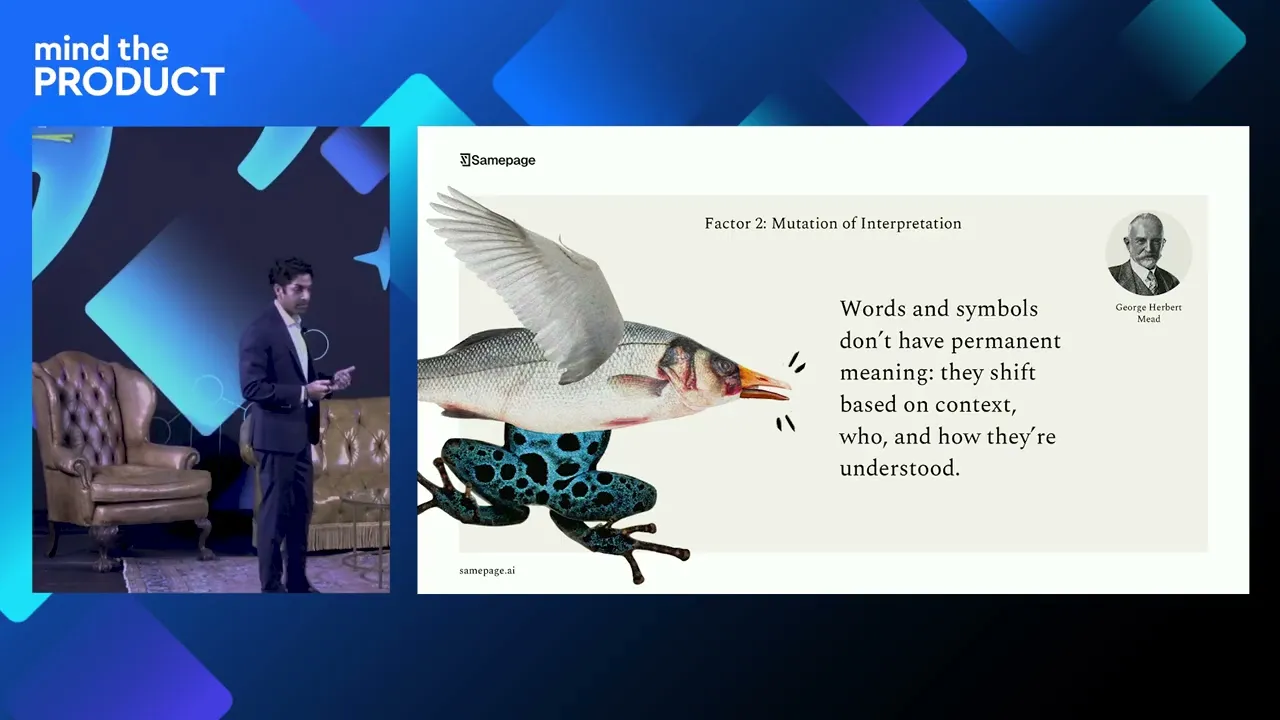
2. Interpretation mutates meaning
People don’t receive messages—they interpret them through their own goals, incentives, and experiences.
3. We over-optimize for efficiency
We compress information into summaries, docs, and quick updates—assuming clarity improves. Often, it does the opposite.
Even perfect communication artifacts—docs, PRDs, AI summaries—can fail if the meaning doesn’t land.
Four ways to improve communication (what we practice at Samepage)
Improving communication isn’t about being more verbose. It’s about being more intentional.
Here are four principles we’ve found to be consistently effective:
1. Lower the bar for alignment
Perfect alignment is unrealistic—and chasing it slows teams down.
Instead, aim for progressive alignment. Even ~70% alignment can be enough to move forward effectively.
When teams stop trying to agree on every detail, they can focus on momentum.
2. Lead with empathy
Every stakeholder processes information differently.
Sales cares about revenue impact
Engineers care about clarity and autonomy
Leadership cares about outcomes
The responsibility is on the communicator to adapt the message—not on the audience to interpret it correctly.
When communication is tailored to the recipient, understanding increases dramatically.
3. Repeat with intention
One of the most underestimated truths: people need to hear things multiple times before they truly internalize them.
Repetition isn’t redundancy—it’s reinforcement.
But it has to be intentional:
Share across different formats (docs, meetings, async updates)
Reinforce key ideas consistently
Adapt the framing for different audiences
If you feel like you’ve said something too many times, you’re probably only halfway there.
4. Use storytelling, not just information
Facts inform—but stories stick.
Research shows that stories are significantly more memorable than standalone information. (Mind the Product)
A simple structure works:
What’s the problem?
What are we doing about it?
Why does it matter?
This is especially critical in product work, where context is often skipped in favor of speed.
Communication is a craft
The biggest mindset shift is this: communication isn’t a soft skill—it’s a craft.
Like product development, it requires:
Iteration
Feedback
Continuous improvement
You don’t get it right once. You get better over time.
Why this matters
When communication improves, everything else follows:
Teams align faster
Duplicate work disappears
Meetings become productive
Products improve
At Samepage, we believe that shared understanding—not just shared information—is what drives great teams.
Because in the end, communication isn’t about what was said.
It’s about whether everyone is truly on the same page.